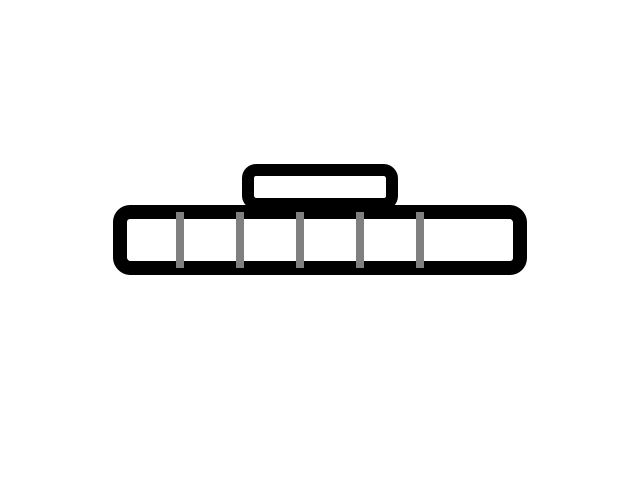
20-series rail, 2000 mm length, standard grade
- Series20
- Length2000 mm
- GradeStandard
A profiled linear guide rail is a hardened, ground steel bar with precisely formed raceways on both sides. A block with recirculating balls or rollers rides on those raceways, so the rail carries the bending and moment loads while the block carries the carriage. The rail decides straightness, stiffness and how accurately two parallel rails track each other; the block decides preload and load sharing. That is why we quote them as a matched set rather than as two unrelated line items. Rails are supplied in standard 15 / 20 / 25 / 30 series and cut to the travel length you specify, with the mounting hole pitch and end machining handled by our partner workshops. A rail cut to the wrong length cannot be reworked, so we confirm the length, the first-hole offset and the hole pitch in writing before the order is placed.
| Variant | What differs | Choose it when |
|---|---|---|
| Standard 15 / 20 / 25 / 30 series | Rail width, height, hole pitch and load capacity rise with the series number | Size the series to the moment load and the space available, not to the motor |
| Ball-type rail | Recirculating balls; lower friction, higher speed | General automation, CNC, packaging, handling axes |
| Roller-type rail | Recirculating cylindrical rollers; higher stiffness and load | Heavy machining, large gantries, high moment loads |
| Standard / high / precision accuracy grade | Running parallelism and height variation across a set | Pick the grade from the axis accuracy you need; a precision rail on an unmachined base is wasted |
| Bolt-down with counterbored holes | Counterbored mounting holes with caps | Standard mounting; caps keep chips out of the counterbore |
| Rust-resistant or surface-treated | Coating or stainless option | Coolant, washdown, clean room, outdoor or marine duty |
| Butt-jointed long rails | Two or more rail lengths joined end to end | Travel longer than a single available length; joint position and matching marks must be specified |
Give the series (15 / 20 / 25 / 30), the travel length, the hole pitch and the first-hole offset at each end, the number of rails on the axis, and the accuracy grade. Then state the load on each block and its direction — vertical, lateral and any moment load — plus the required preload, the operating speed and duty cycle, and the environment (coolant, chips, dust, washdown, vacuum). Include the mounting base flatness and the parallelism you can hold between two rails, because a precision-grade rail bolted to an unmachined frame will not deliver its rated accuracy. Tell us whether the rails must come from the same production lot as the blocks, and whether you need end machining, caps, grease fittings or a specific lubrication direction. Cutting and end machining are handled by our partner workshops; we record the cut length and hole pitch against the lot on the inspection report.
Our rails are supplied to standard 15 / 20 / 25 / 30 series dimensions. A rail in a given series is compatible with standard 15 / 20 / 25 / 30 series blocks of the same series and accuracy class. When an existing axis uses a different numbering system, send the rail width, the hole pitch, the block mounting pattern and the assembly height: those four values are what we cross-reference to the correct series, and what we cross-match between an old rail and a current one. Parts described as interchangeable with standard series are matched on those four dimensions and on the preload class, not on a name.
We state interchangeability only as standard series compatibility. We do not claim any brand authorization, and we do not list third-party brand names as our own products. If you are unsure which series is on your machine, put the four measurements and a photo of the block mounting face in the RFQ and we will confirm the fit before quoting.
CNC machining centres and lathes, laser and plasma cutters, gantry and Cartesian robots, industrial 3D printers, semiconductor and electronics handling equipment, automated assembly and packaging lines, measuring and inspection stages, woodworking machinery, medical and laboratory automation, and any axis that must hold position under a moment load. On a long axis the deciding question is almost always the flatness of the base and the parallelism of the two rails, not the catalogue load rating.
Most rail enquiries come from a machine with a dented or corroded rail, or from an axis being lengthened. Measure the rail width, the centre-to-centre hole pitch, the distance from the rail end to the first hole, the overall assembly height with the block fitted, and the block mounting hole pattern. Photograph the end face and the block flange. We cross-reference those values to the standard series and confirm the cut length, first-hole offset and hole pitch in the first reply. If only one rail of a pair is being replaced, say so: mixing a new rail with a worn rail on the same axis changes the parallelism and the preload, and we will quote the pair instead of leaving you with a binding carriage.
A rail is only half the axis. Order the blocks in the same series, accuracy class and preload as the rail — we ship the matched set from one lot at the partner factory, with the series, length and preload on one packing list.
Yes. Cutting and end machining are handled by our partner workshops. Send the overall length, the hole pitch and the distance from each end to the first hole; we confirm all three in writing before the order is placed. A rail cut to the wrong length cannot be reworked, so we do not start cutting until you approve those values.
Size it from the moment load and the space available. If you are replacing an existing rail, send the rail width, hole pitch, block mounting pattern and assembly height and we will cross-reference them to the series rather than guess from the machine type.
For a precision axis, yes. We ship the matched set from one lot at the partner factory and put the series, length and preload on one packing list. For a general replacement you can order a single rail, but tell us whether the other rail of the pair is still in service.
Send the bore, outside diameter, width and the duty in one RFQ. We confirm the fit before quoting and state MOQ, lead time and Incoterms.